
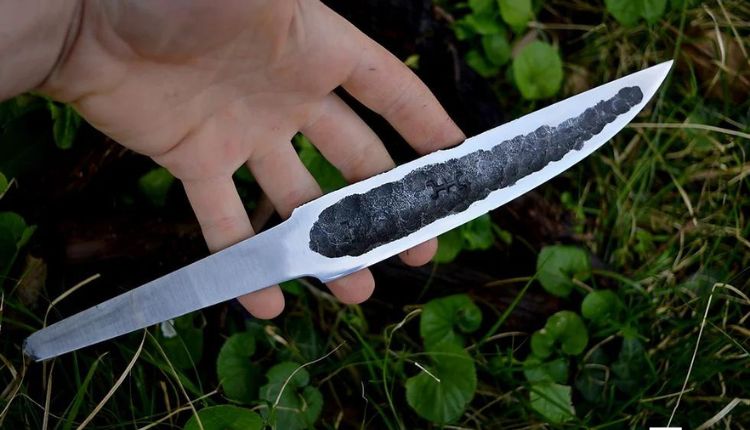
A water knife is a specialized knife used to prepare ocean fish. It is traditionally carved by hand from a piece of birch bark. The knife has a strong handle tapering both in height and thickness to the blade. It is egg shaped in cross section and fits the hand very well.
Handle
A Yakut knife handle is the part that grips the blade. It can be made from many different materials, including plastic, wood, bone, ivory (usually elephant ivory or walrus penis bone), sheep horn, buffalo horn, teeth and mop (mother of pearl). Some handles are also textured to enhance grip. This particular knife is made with a birch burl handle, glued to the tang using epoxy. The birch is thick and egg-shaped in cross section, so the handle feels comfortable in the hand even when wearing gloves. The birch also protects the hands from the cold steel of the knife blade. A cow tail knife sheath completes the ensemble.
The blade is forged from Kh12MF, which is an excellent steel for knife making. It is resistant to corrosion, wear and compressive loads. The hardness of the steel is approximately 60-62 HRC. This makes it an extremely durable and sharp knife that can be used for years. The knife planes, shaves and splits very well.
Blade
Knives are a tool that is used for many different purposes. They are commonly used as a weapon or for food preparation and can also be worn as a part of an ethnic costume. A knife can be made of many types of metal or even plastic, but the most common are stainless steel knives. The blade of the water knife is slender and long. It has a trailing or slightly up-swept point that distinguishes it from other blade shapes. It is asymmetrical with one side having a fuller (a groove) and a chisel grind, while the other has no such feature and is basically a convex edge.
The handle of the knife is traditionally made of birch burl, which is thick and egg-shaped in cross-section. It is comfortable to hold and fits well in the hand, especially when wearing gloves. It also helps protect the hands from the cold effects of the knife steel during use.
Sheath
The leather sheath of the modern Yakutian knife is made from birch burl and can be made with basic leatherworking tools. First, the wood is cut to size and sanded down to remove any scratches. Then, it is stitched together using a saddle stitch. The next step is to make a stitching pony which can be done with a 2X4 and a carriage bolt or wing nut. The knife is then slipped into the sheath and clamped in place before it is stitched together.
This beautiful knife features a wild damascus blade and handle with patinated reindeer antler. It also includes a high-quality cowhide sheath for added protection. This is a sturdy forester’s knife that can withstand a lot of use and will impress all your friends around the campfire. It is an excellent knife for hunting, processing fish and performing general cutting tasks. The asymmetrical design of the blade is unique, as one side has a fuller (groove) and chisel grind while the other side has no groove.
Weight
In Yakutia, knives were forged with the help of a special iron ore. Moreover, they knew how to smelt it, bypassing the stage of casting. This enabled them to save the durable material for the blade. The knife was used for hunting and for work on the land. It was also a valuable heirloom handed down to young children. The knife was worn on the left side, allowing hunters to quickly pull it from its sheath in one hand.
Traditionally, the knife was forged with a trough on one side. It made it easier to hold in the cold. The trough also made it lighter and helped the knife to stay afloat in water. The Yakut knife is a unique tool for people who live in the far north wilderness. It is a symbol of their survival skills and ability to adapt to harsh conditions. It is a great tool for bushcraft, camping, hunting, and fishing.
Conclusion
This is a peculiar knife used in everyday life and hunting by the inhabitants of Yakutia. It is one of the most recognizable objects of local culture. The scabbard is made from a bull’s tail skin removed with a stocking and fixed by wedges of birch bark or wood. The main feature is the asymmetrical profile of the blade.
