
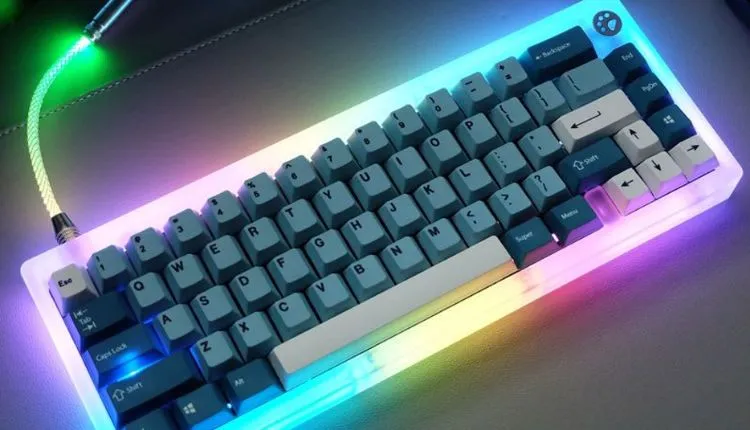
See this article for a summary of the essential mechanical keyboard components for beginners. We discuss PCB layout, keyboard enclosures, and more!
Whether you are using a standard browser or a custom computer, mechanical keyboards are available in various sizes and forms for every user type. The use of mechanical keyboards is becoming quite popular. Making one’s mechanical keyboard is becoming increasingly popular.
Knowing where to begin is occasionally the most difficult aspect of a project. Because of this, a mechanical keyboard parts list is a crucial resource for getting started with your DIY project.
Choosing A Size
By the way, practically everyone uses a keyboard. Yet, they are not universal. For various demands and tastes, keyboards are available in various sizes. The most popular percentages for size are 100%, 90%, 80%, and 65%.
You can choose the best layout for you using the list that follows:
100%
All 104 keys on a conventional keyboard are included in the 100% 100% layout. Includes 10 number keys. Non-specialized keyboards are typically 100% as most people are accustomed to using them.
90%/96%/1800
There are less than 1800 keyboards around. Yet, most or all conventional keys are arranged in a simpler configuration on 100% of keyboards. With 90% and 96% of keyboards, the 1800 design is used. Along the process, they frequently misplace various keys, such as the Lock and Pause buttons.
80%(TKL)/75%
For users who do not regularly handle numbers, the 80% keyboard layout is the most common mechanical keyboard layout if the 100% keyboard is the most popular standard. The initials “TKL” are “tenkeyless,” as 80% of keyboards and smaller ones lack a number pad. Zabar
65% And Smaller
Because of its small size and practicality, the 65% mechanical keyboard size is another well-liked size. 70% of keyboard function rows need to be recovered. A keyboard’s number of rows, arrow key combinations, and other function keys are lost on keyboards less than 65% of its size (for instance, 60%, 50%, and 40%).
Case And PCB
The PCB and casing will be the building blocks of your keyboard once you’ve determined the ideal size for your requirements. The foundation of your keyboard, the printed circuit board (PCB), recognizes keystrokes and transmits data from your keys to your computer.
The case involves many materials. Aluminum and plastic are the most often used materials since they are simpler to make. The PCB is one of the materials, in addition to wood, acrylic, and other things.
Stabilizers
The most alluring feature of mechanical keyboards is the quiet click of the keys. Because the keyboard’s sound and feel are crucial. You don’t want to ratchet and wiggle.
Without a stabilizer, large keys behave like a swing. Thanks to the stabilizer, the huge keys look fine, exactly how they are. They are using your regular-sized keys.
The width of the keys, where 1u is the size of a conventional key, is the unit of measurement for keyboard measurements. For bigger keys (like shift or backspace), such as a spacer, you may purchase a 2u stabilizer. The spacebar may be 7.25u instead of 6.25u on special-sized keyboards.
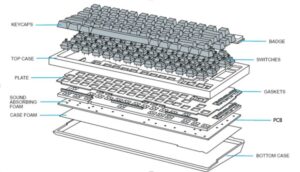 The Cherry and Costar forms of mechanical keyboard stabilizers are the two most common varieties.
- The Cherry-style stabilizer comes from the well-known Cherry MX switches. The flexibility to change the design, color, and material makes these stabilizers the most popular for many reasons.
- Since coaster stabilizers are more challenging to install, they are less prevalent. Older mechanical keyboards often include coaster stabilizers. Although it is still used today, the Cherry-style gimbal’s adaptability has rendered it obsolete.
Switches
The sensation of the switches is what most distinguishes a mechanical keyboard from a membrane keyboard. And the Switch itself is largely responsible for that sensation. (Plate mounting and arrangement also have an impact here.) A PCB, mounting plate or frame can all be right on top of the Switch for mounting.
- Smooth resistance is delivered with each keystroke using linear switches. They lack tactile feedback for keystrokes and are the quietest of the three. As a result, linear. Among the three switches, linear switches are the quietest and smoothest.
- The midway ground between the three possibilities is the tactile Switch. When the keyboard is pressed, there is a tiny bump and click in addition to more resistance than a linear switch. They operate more quietly than click switches but more quickly than linear switches. Those who prefer the tactile sensation of mechanical keyboards but dislike the loud sound of linear or clicky switches frequently opt for tactile switches.
- switches that click. As you would have predicted, they have a louder click than linear or tactile switches. The button has a tactile feel when a clicky switch is pressed and fully released. These switches are the three that are most distinctive, as a result, for keyboard users that favor mechanical sound. Switches with a clicky action have the best sound and feel.
Keycaps
The keys make up most of a mechanical keyboard’s look, second only to the frame. Besides the switches, the keypad is the most noticeable component. Keycaps may be made of a variety of materials. However, ABS and PBT are the materials that are most frequently utilized.
Abs (Acrylonitrile Butadiene Styrene)
ABS is a soft material typically used in entry-level keyboards (except GMK, which sells ABS keycaps of the highest caliber). It reduces the cost of manufacturing the keycaps. But it also quickly degrades the keycaps. With extensive use, ABS keycaps are prone to looking glossy and shiny because the friction of the fingertips can erase the surface of the buttons.
PBT (Polybutylene Terephthalate)
It is a sturdier and longer-lasting substance. Smooth PBT keycaps won’t rust over time because of their construction. As a result, it is a popular option for expensive mechanical keyboards.
Keyboard Accessories
It would only be a mechanical keyboard with peripherals and accessories that enhance its configuration and functioning.
- Desk Pad: The desk pad functions as a keyboard and mouse pad. It has a plush, squishy desktop that improves the mechanical keyboard’s appearance and feels.
- Cable: The coiled USB wire is one of the mechanical keyboard’s most recognizable components. To distinguish mechanical keyboard USB cables from those used with conventional membrane keyboards, they are frequently detachable and have distinctive colors.
- Lube: For beginners, strong mechanical keyboards are ideal. Most significantly, mechanical keyboards continue to function properly. Mechanical keyboard repair and upkeep depend heavily on switch lubricants.
The construction of a mechanical keyboard requires the following 8 components: PCB, Case, Stabilizer, Switch, Keys, Desk Mat, Cable, and Switch Lubricant. No matter if you are a weather expert or a novice!
